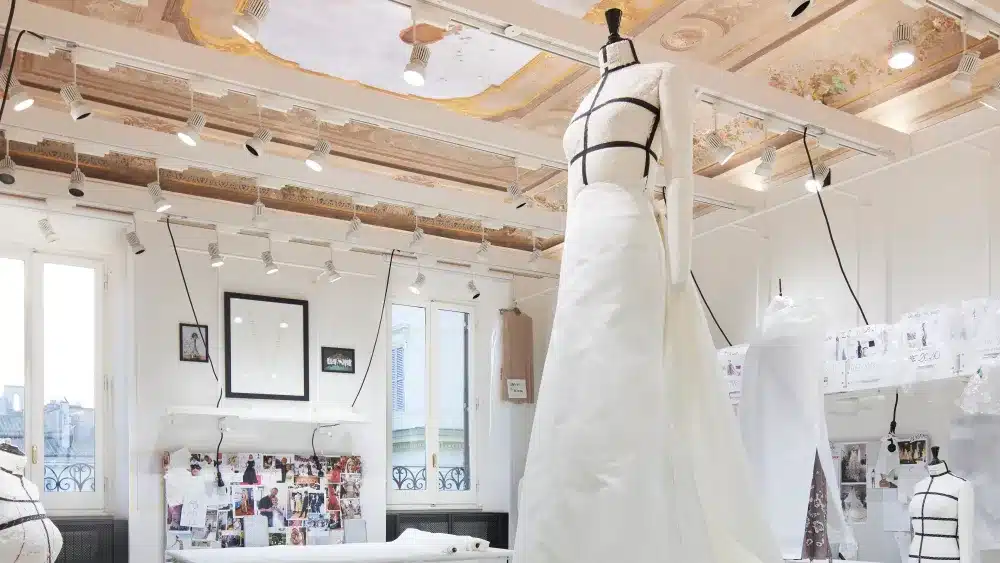

For decades, Italian fashion told a very specific story. It was a story of family-run ateliers, charismatic founders, and businesses rooted in cities rather than stock portfolios. Luxury was built slowly, stitched by hand, shaped by personality and place.
That story began to change in the late 1990s. And few brands illustrate this shift more clearly than Valentino.
What happened to Valentino is not just the evolution of a fashion house. It is the blueprint of how luxury moved from craftsmanship to capital.
When fashion stopped being “family business”
Founded in Rome in 1960 by Valentino Garavani and Giancarlo Giammetti, Valentino remained, for nearly four decades, a rare exception in global fashion: a major maison still controlled by its founders.
By the mid-1980s, Italian designers were celebrated worldwide as symbols of creative independence. Milan was not just a fashion capital; it was the nerve center of a system where ownership, design, and production still aligned.
That equilibrium ended in 1998, when Valentino was sold to the Italian holding HdP for roughly $300 million. The company stayed Italian on paper, but the logic changed overnight. Valentino was no longer just a couture house. It became an asset.
The era of ownership churn
What followed was a rapid sequence of ownership changes that would have been unthinkable in earlier decades.
In 2002, Valentino was acquired by the Marzotto Group, historically tied to textile manufacturing. The idea was industrial integration. The result was further distance between the brand and its artisanal origins.
Five years later, in 2007, the real turning point arrived: control passed to Permira, a British private equity fund. One year after the deal, Valentino Garavani retired from fashion. The timing was symbolic. The founder stepped away just as the brand completed its transformation into a financial vehicle designed for scalability, margin growth, and resale value.
At that point, Valentino no longer belonged to Rome. It belonged to the global investment cycle.
Sovereign wealth enters the fashion system
In 2012, Valentino entered a new phase when it was acquired by Mayhoola for Investments, backed by Qatar’s ruling family. The valuation—around €700 million—reflected a new reality: luxury brands had become long-term strategic holdings for sovereign wealth funds.
Under Mayhoola, Valentino expanded globally, strengthened its positioning, and regained cultural relevance. From a creative standpoint, the brand flourished. From a structural one, it moved even further away from national ownership.
Luxury, by then, had fully detached from geography.
The French connection and the future of Valentino
In July 2023, another chapter opened. Kering, the French conglomerate behind Gucci and Saint Laurent, acquired 30% of Valentino for €1.7 billion in cash. The deal included an option to acquire the remaining shares, originally set for 2028 and now expected to move to 2029.
The numbers tell the story better than any metaphor.
In 1998, the entire company was valued at $300 million.
In 2023, a minority stake alone commanded nearly six times that figure.
Value multiplied. Ownership vanished.
If the acquisition is completed, Valentino will become fully integrated into the French luxury system—another Italian name managed, optimized, and monetized from abroad.
What Valentino represents today
Valentino’s trajectory mirrors what happened to most historic Italian fashion houses. Creative identity remains Italian. Production often stays Italian. Storytelling is deeply Italian.
But control, profit, and strategy belong elsewhere.
For American audiences, this matters because it reveals how modern luxury actually works. What appears timeless and romantic on the runway is often governed by the same logic that drives mergers, debt management, and shareholder returns.
Luxury today is less about who designs the dress—and more about who owns the brand behind it.
From couture dream to financial reality
Valentino is still synonymous with elegance, beauty, and craftsmanship. That hasn’t disappeared. What has changed is the framework surrounding it.
The Roman atelier gave the brand its soul. Global finance gave it scale.
And in that tension—between artistry and asset management—lies the true story of contemporary luxury.