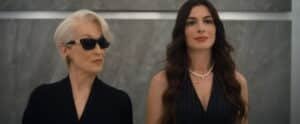
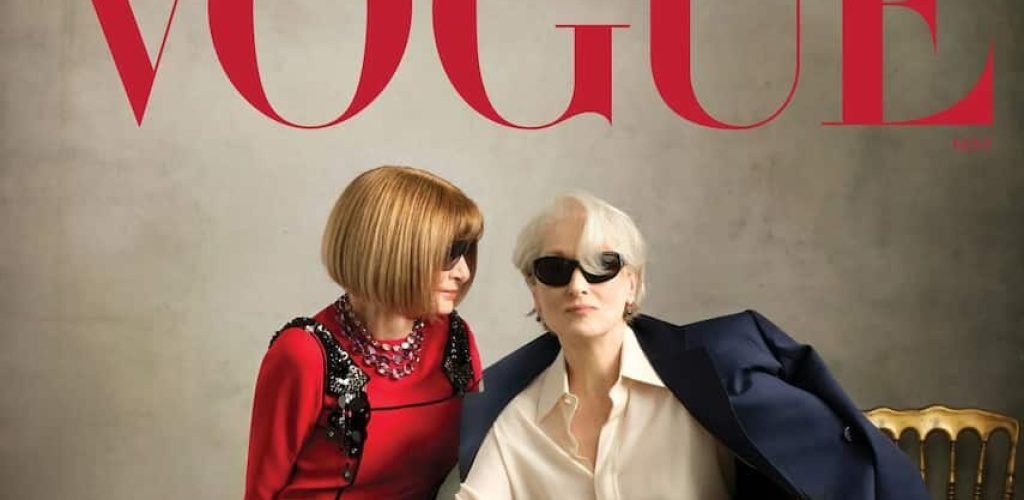
The set is quiet, almost staged in its restraint. A wooden platform, two chairs, the neutral tension of a studio that knows it is about to produce something meant to last. Anna Wintour sits composed, immovable in her signature silhouette. Across from her, Meryl Streep—inhabiting Miranda Priestly once again—leans into the fiction that has followed Wintour for nearly two decades. The image is controlled, deliberate, and unmistakably aware of its own weight.
It does not read like a simple cover. It reads like a correction.
When Anna Wintour steps into Vogue, the narrative shifts
For the first time, Anna Wintour appears on the cover of Vogue. Not as an abstract authority behind the magazine, but as part of its visual language—its most powerful one. This alone would be enough to mark a shift. But the context makes it sharper.
The timing aligns with the return of The Devil Wears Prada, a cultural artifact that has long blurred the line between fiction and biography. By placing Wintour alongside Streep—who famously embodied a version of her—the magazine collapses that distance entirely. It does not deny the myth. It absorbs it.
This is where the move becomes strategic.
Wintour has spent decades maintaining distance: controlled appearances, minimal emotional exposure, a public voice that reveals little. That restraint built her authority. Yet in this moment, she steps into a narrative that once threatened to define her from the outside.
Now, she defines it from within.
Vogue, memory, and the power of visual resets
Fashion has always understood something the internet pretends to forget: images rewrite memory faster than words ever could.
The cover operates on that principle. It does not argue. It replaces.
Over the years, The Devil Wears Prada shaped a collective perception of Wintour—cold, demanding, untouchable. Whether accurate or exaggerated became almost irrelevant. The image stuck. The story circulated. The persona solidified.
What this Vogue cover does is not dismantle that narrative. It reframes it.
Placed within the controlled aesthetics of Vogue, styled with precision and photographed with the authority of Annie Leibovitz, the same traits that once felt severe now read as iconic. Distance becomes mystique. Control becomes discipline. Silence becomes power.
It is not a denial of the past. It is a recalibration of how that past is seen.
The Anna Wintour paradox: presence without exposure
There is a contradiction at the center of this moment.
Wintour participates. She sits, she engages, she allows herself to be placed inside a cultural reference that has followed her for years. Yet she does not fully reveal herself. The distance remains intact.
This balance has always defined her.
Unlike the cinematic version—Miranda Priestly, who occasionally reveals flashes of vulnerability—Wintour’s public persona rarely cracks. She does not overshare. She does not dramatize. She does not explain.
That restraint has often been interpreted as coldness. But in a media landscape built on constant exposure, it functions differently. It creates scarcity.
And scarcity, in fashion, translates into value.
The Devil Wears Prada was never just fiction
The relationship between Anna Wintour and The Devil Wears Prada has always been more complex than a simple “inspiration.”
The film—and the novel before it—captured something real about the structure of fashion power: the hierarchy, the pressure, the blurred boundaries between personal and professional life. Assistants running personal errands, careers built on proximity to influence, the constant negotiation between ambition and exhaustion.
That system existed. It still does, in different forms.
But the cultural reception of the story shifted over time.
What once felt like an exposé now reads, to many, as exaggerated—or even nostalgic. The idea of enduring extreme conditions for access to an elite world feels out of sync with a generation that questions those dynamics more openly.
This is where the Vogue cover becomes particularly sharp.
By revisiting the narrative now, Wintour is not just engaging with her past. She is repositioning it within a different cultural context.
Assistants, power, and the invisible structure of fashion
One detail from the original narrative continues to resonate: the role of assistants.
They were never just administrative support. They were extensions of power. They managed schedules, controlled access, filtered communication, and often absorbed the emotional weight of the system.
Inside Condé Nast, this structure was not unique to Wintour. It was part of a broader culture where proximity to influence came with invisible labor.
The reckoning that followed in recent years—particularly around workplace dynamics—forced that structure into visibility. What had been normalized became questioned.
Yet the Vogue cover does not engage directly with that tension. It does something subtler.
It shifts the focus back to image.
And in doing so, it reminds us of a fundamental truth: in fashion, image often outruns accountability.
Why this Vogue cover works now
Timing is everything, and this moment is precise.
The sequel to The Devil Wears Prada is approaching. Nostalgia cycles are accelerating. The fashion industry itself is navigating a period of redefinition—between legacy institutions and digital disruption.
Within this context, the cover functions on multiple levels:
- It capitalizes on cultural memory
- It reasserts editorial authority
- It repositions Wintour within a narrative she once stood outside of
But more than anything, it demonstrates control.
Wintour is not reacting to the narrative. She is orchestrating its next chapter.
The aesthetics of authority
There is also something to be said about the visual language itself.
The styling, the posture, the composition—all reinforce a specific idea of power. Not loud, not exaggerated, but precise. Controlled. Intentional.
This is not the chaotic energy often associated with fashion today—the rapid turnover of trends, the constant push for novelty.
It is something older. More stable.
It reflects a version of fashion that still believes in hierarchy, in editorial direction, in the authority of a single vision.
And perhaps that is part of the appeal.
In a landscape where everything is accessible, authority becomes rare. And rarity, once again, becomes valuable.
A legacy edited in real time
Legacy is not something that gets written once. It is constantly adjusted, refined, reinterpreted.
This cover is part of that process.
For Anna Wintour, whose career spans decades of cultural shifts, maintaining relevance is not just about staying visible. It is about staying in control of the narrative.
The decision to step onto the cover of Vogue—to engage directly with the mythology surrounding her—suggests a recognition of that.
It is not a departure from her established persona. It is an evolution of it.
And it raises an interesting question: how much of a legacy is shaped by what actually happened, and how much by the images that remain?
The image that stays
In the end, what lingers is not the discussion, not the analysis, not even the context.
It is the image.
Anna Wintour and Meryl Streep, side by side, collapsing fiction and reality into a single frame. A moment that feels both staged and inevitable.
Fashion has always known how to do this—how to turn complexity into a single, lasting visual.
And perhaps that is the real purpose of this cover.
Not to explain. Not to defend.
Just to replace what came before.
Join our Community:
https://t.me/vintageitalian
https://vintageitalianfashion.substack.com/