
How an embroidered shawl became a symbol of Spain, revealed the contradictions of empire, and anticipated today’s debates about identity and fashion
Fashion has always excelled at disguising complexity. Few garments prove this better than the Manila shawl: celebrated as one of Spain’s most iconic accessories despite originating thousands of miles away in southern China.
That paradox lies at the heart of new research by Inés Corujo Martín, who argues that the Manila shawl was far more than an elegant piece of embroidery.
The story feels surprisingly contemporary. In an era when luxury brands constantly debate authenticity, craftsmanship and cultural heritage, the Manila shawl reminds us that fashion identities have rarely
A Global Luxury Before Globalisation
Despite its name, the Manila shawl was produced primarily in Canton, southern China. It travelled west aboard the Manila Galleons, the vast maritime trading network linking Asia, the Americas and Europe between the sixteenth and early nineteenth centuries.
Silks, porcelain and lacquerware crossed the Pacific before continuing across New Spain and eventually reaching Seville. Among these luxury goods was an embroidered silk shawl that would eventually become inseparable from Spanish dress.
Rather than remaining an imported curiosity, the garment evolved. Chinese motifs gradually gave way to carnations, roses and other floral patterns favoured in Spain, while the distinctive macramé fringe reflected Iberian textile traditions. What emerged was neither entirely Chinese nor entirely Spanish, but the product of centuries of cultural exchange.
Long before the term “global fashion” entered industry vocabulary, the Manila shawl embodied it.
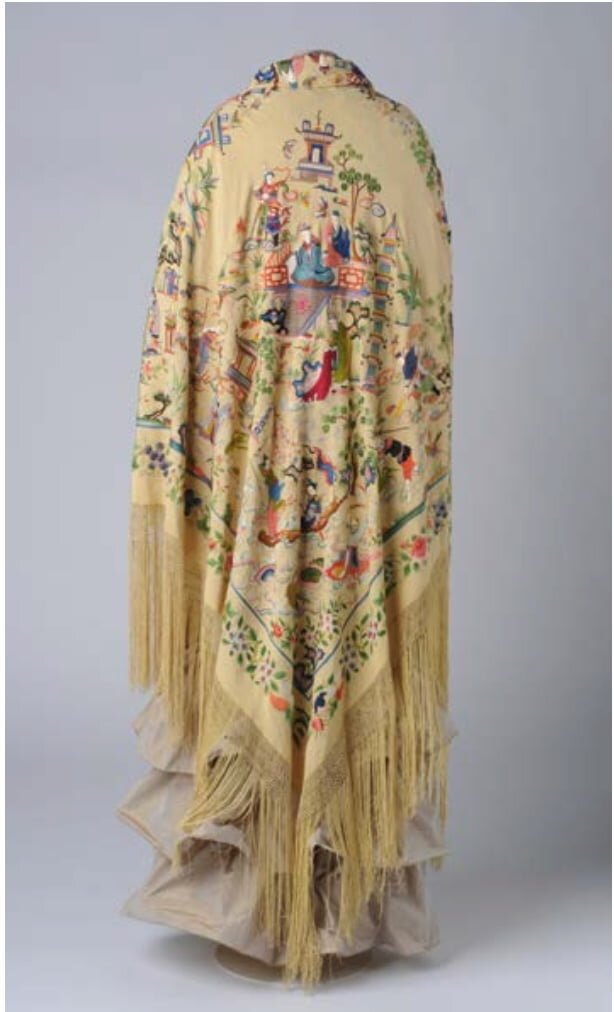
©Museo del Traje. CIPE, Madrid.
When Clothing Becomes Politics
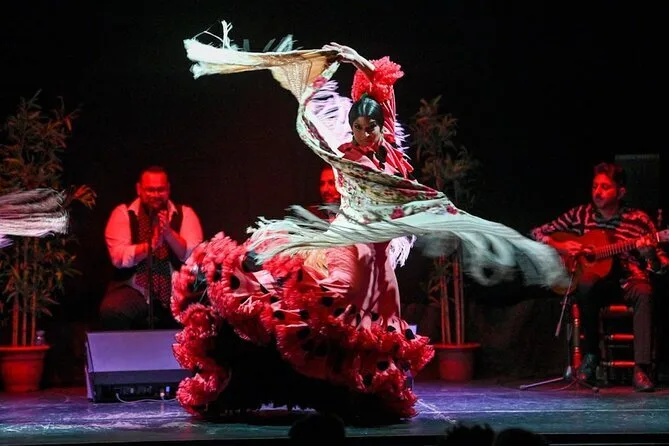
By the second half of the nineteenth century, the shawl had moved beyond elite wardrobes. It appeared across social classes, worn by aristocrats and market vendors alike, by Andalusian women, Madrid’s manolas and Seville’s famous cigar workers.
Painters including Joaquín Sorolla, Ramón Casas and Julio Romero de Torres repeatedly placed the garment at the centre of their compositions. Advertising soon followed, turning the shawl into an instantly recognisable symbol of Spanish identity.
Its popularity coincided with a period of profound uncertainty. Spain was confronting industrialisation, political instability and the gradual collapse of its colonial empire. Questions about what it meant to be Spanish increasingly surfaced not only in politics and literature but also in clothing.
Fashion became a language through which national identity could be negotiated.
Galdós Dresses a Nation
Benito Pérez Galdós understood this instinctively.
In Fortunata y Jacinta, clothing never functions as decoration. Every garment carries social, political and emotional meaning.
The Manila shawl belongs above all to Fortunata, the novel’s working-class heroine. Wrapped in its embroidered silk, she represents a popular Spain rooted in tradition, instinct and resilience. Her counterpart, Jacinta, embraces the refined fashions arriving from Paris, reflecting the aspirations of Spain’s rising bourgeoisie.
The contrast extends beyond personal style.
As Paris establishes itself as Europe’s fashion capital, brightly coloured Manila shawls begin disappearing from elite wardrobes. French tailoring, subdued colours and industrially produced garments replace the vivid textiles associated with Spain’s colonial past. Galdós presents this transition as more than a shift in taste. It reflects a broader cultural realignment in which modernity increasingly means looking north rather than looking inward.
The wardrobe becomes a political map.
The End of an Empire, Woven in Silk
Perhaps the most compelling argument emerging from Corujo Martín’s research is that the Manila shawl mirrors Spain’s imperial trajectory.
Initially a luxury object imported through colonial trade, it eventually becomes a democratic garment embraced by ordinary people. As Spain loses its overseas possessions, the shawl survives not among the country’s elites but within popular culture, where it preserves a memory of national identity that official political narratives struggle to maintain.
This transformation gives the shawl remarkable symbolic power.
Its embroidered flowers evoke beauty, yet its history is inseparable from colonial commerce. It celebrates craftsmanship while exposing global supply chains that stretched across continents centuries before the fashion industry became international.
It is simultaneously local and global.
Traditional and cosmopolitan.
Spanish and unmistakably Asian.
Why It Still Matters
Today’s luxury industry frequently speaks about heritage, authenticity and cultural identity. Brands build entire collections around notions of national craftsmanship while simultaneously relying on global production networks, multicultural design teams and international markets.
The Manila shawl reminds us that this apparent contradiction is nothing new.
Objects we celebrate as national icons often emerge from centuries of exchange, adaptation and migration. Fashion identities are rarely inherited intact; they are assembled, negotiated and continuously rewritten.
That may be the Manila shawl’s greatest lesson.
It was never simply an accessory. Nor was it ever exclusively Spanish or Chinese.
It became something far more interesting: a textile archive of global history, proving that fashion has always crossed borders long before politicians drew them.
Join our Community: