
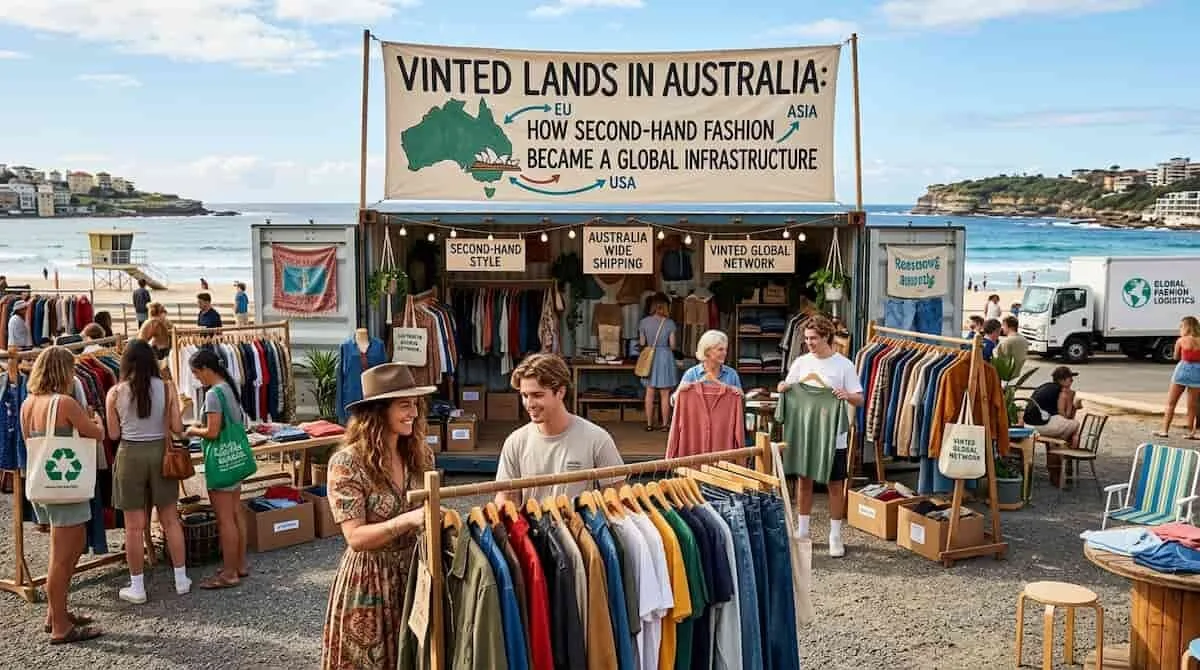

Across Australia this July, the parcel lockers outside post offices started wearing someone else’s branding. Wraps, decals, kiosk screens — a three-year partnership between Australia Post and a Lithuanian resale marketplace turned a piece of everyday postal furniture into a billboard for used clothing. It’s a small, physical detail, but it says something larger: this is what a platform launch looks like when the product isn’t an app, it’s a logistics network.
Vinted’s Australian debut, which went live on 1 July 2026, is not simply the story of another shopping app arriving Down Under. It’s the latest data point in a shift that has been building for years — the point where second-hand fashion stops being a series of local marketplaces and starts behaving like a single, interconnected system. One buyer who has used Depop, eBay and Whatnot for years told Guardian Australia that Vinted’s arrival felt like “a genuine gamechanger.” The claim is worth taking seriously, and worth interrogating.
What Actually Changes When a Resale Platform Goes Global?
Vinted was founded in Vilnius in 2008, on the unglamorous premise of not wanting to throw clothes away. Eighteen years later it operates in roughly two dozen markets, generated €1.1 billion in revenue in 2025 (up 38% year on year), and has become, according to its own reporting, the largest seller of clothing by volume in France — ahead of Shein, LVMH and Amazon. Australia is its 27th market.
The mechanics of the Australian launch follow the template Vinted has used elsewhere: no listing or selling fees, prepaid shipping labels once an item sells, and a “Buyer Protection” fee — 5% of the item price plus $0.70 — charged to the buyer instead. What’s new is the international layer bolted onto it from day one. Australian sellers are connected to the UK market through a shipping corridor built with InPost, meaning a coat listed in Perth can, in principle, be bought by someone in Manchester, provided it weighs under 2kg and is valued below £110. That threshold is not incidental — it is the seam where “global second-hand” quietly turns into “global second-hand, with conditions.”
This is also where the brief that inspired this piece needed a correction: the United States is not a market Vinted is merely eyeing. The company launched there in January 2026, starting in New York, with tens of millions of dollars committed to brand-building and logistics. Australia and the US are not sequential ambitions — they are two fronts of the same expansion, running in parallel.
The Australian Numbers, and What They’re Actually Measuring
Research commissioned by Vinted ahead of the launch — so a source with an obvious interest in a favourable result, worth reading with that in mind — found that 91% of Australians have bought or sold something second-hand, and 88% say they have items at home they could sell. Independent market forecasts, cited by Australia Post’s own e-commerce report, put the country’s recommerce sector at roughly US$6.75 billion by 2029. None of that guarantees Vinted’s success against an entrenched eBay or a newly consolidated Depop — eBay acquired Depop earlier this year — but it does explain why a European platform with no prior Australian footprint judged the market worth a national advertising campaign rather than a quiet regional trial.
Did you know? Vinted's Australian entry didn't come with a press conference. Its local website went live with active listings before any official announcement — a "quiet launch" pattern the company has used in several markets, letting word of mouth and app-store visibility do the early work before the marketing budget arrives.
The Contradiction Nobody’s Fully Answered Yet
Here is the tension the platform’s own growth creates. A wider, more liquid market increases the odds that any given vintage or second-hand piece finds a buyer — a linen jacket that might sit unsold in a small local market for months has a better shot at a match across two hemispheres. That’s a real gain, and it’s the argument circular-fashion advocates have made for years: an item’s environmental cost is amortised the longer, and the more widely, it stays in use.
But wider circulation also means longer shipping distances, and shipping has its own footprint. Whether a cross-border resale transaction is, net, better for the planet than a shorter-range one depends on variables — mode of transport, packaging, how many times an item changes hands before it’s actually worn again — that no single company’s marketing page settles. This is not a claim anyone has proven either way in the sources available for this piece; it’s an open question the industry has not resolved, and it’s worth naming as exactly that rather than assuming the answer in either direction.
Who Benefits When the Wardrobe Has No Border?
The likely winners of a borderless second-hand market are not evenly distributed. Buyers get access to inventory that simply didn’t exist locally — a European archive piece, a UK-only silhouette, an item from a brand that never had Australian distribution. Sellers with an eye for what travels well — lightweight, distinctive, easy to photograph — gain a market that used to be closed to them entirely. But the same scale that helps a careful seller also professionalises the competition: as platforms grow, so does the number of high-volume resellers treating the marketplace less like a wardrobe clear-out and more like inventory management, which changes what a casual seller is actually up against.
Insider tip: On platforms with an international corridor like Vinted's UK–Australia link, weight and declared value limits (here, under 2kg and £110) usually decide what's worth listing internationally at all. Before assuming a piece will find a global buyer, check whether it clears the threshold — otherwise it's competing only in the local pool.
The Question Worth Sitting With
The framing that matters here isn’t whether Vinted succeeds in Australia — plenty of well-funded platforms have entered promising markets and struggled against entrenched incumbents, and eBay’s local presence is not going anywhere. It’s whether “vintage” and “second-hand” are drifting toward meaning something closer to “available,” full stop, regardless of where an item actually sits in the world. A market that optimises for finding any buyer, anywhere, is not automatically the same as a market that helps you find the right buyer, nearby — the one who might actually wear the piece next week rather than three shipping legs from now.
Vinted’s marketplace CEO, Adam Jay, put the company’s ambition plainly: the goal, he said, is to “make second-hand the first choice.” Whether that choice ends up being made two suburbs away or two continents away is the part still being written.
Join our Community: