
Rome has never been just a backdrop for Fendi. It is part of the material.
You can read it in the pale stone, in the monumental facades, in the theatrical rhythm of courtyards and palazzi, in the way a surface can look architectural before it becomes decorative. For Fendi, Rome is not a postcard attached to a collection. It is the city where the house was founded in 1925, the place where leather goods, fur, accessories, family labour and a very specific kind of Roman elegance became a luxury language.
That is why Fendi’s return to Rome during Haute Couture Week should not be treated only as a location choice.
It is a statement about where luxury is looking now.
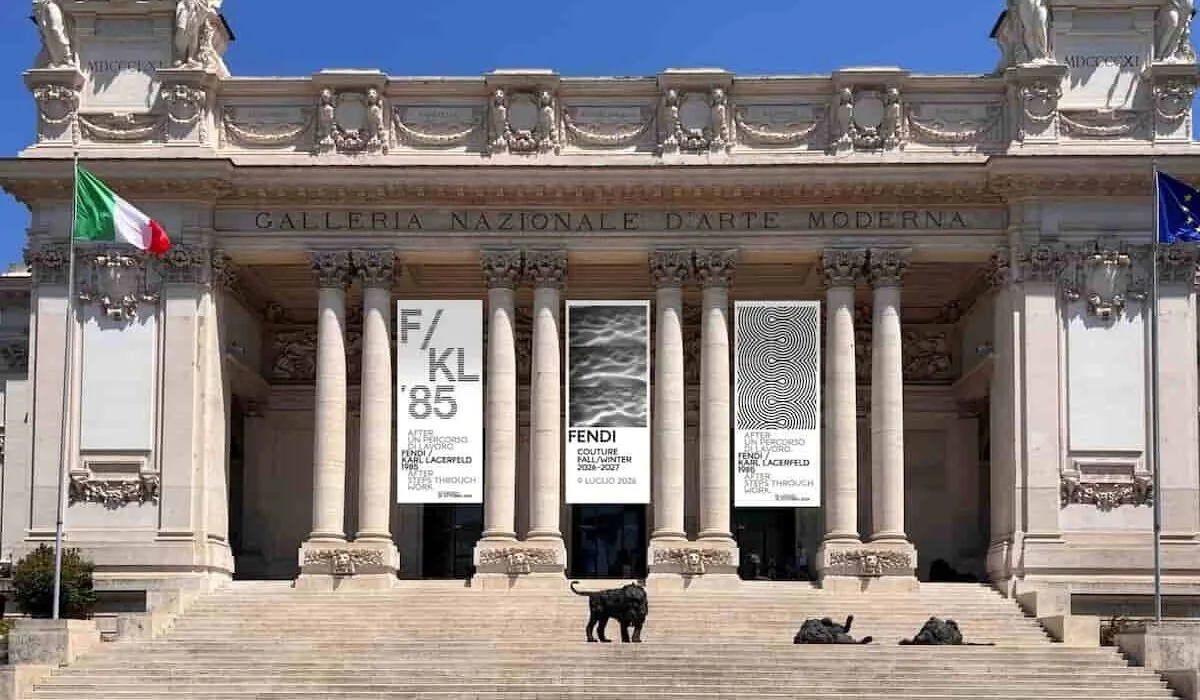
According to the Haute Couture Week previews published by Wallpaper and Vogue, the July 2026 couture calendar is built around several major creative debuts and returns. Fendi moves its show to Rome, at the Galleria Nazionale d’Arte Moderna, under Maria Grazia Chiuri’s direction. The setting matters because Fendi’s history is unusually tied to place: not in a folkloric way, but through architecture, cinema, craftsmanship, accessories and the long memory of a family-led Roman house.
The contemporary luxury system often speaks about heritage.
Fendi has a chance to make the word concrete.
Why Rome Matters to Fendi
Fendi was founded in Rome in 1925 by Adele and Edoardo Fendi as a house connected to fur and leather goods. The second generation, the five Fendi sisters, turned that Roman workshop into a modern luxury house without erasing its family structure. Paola, Anna, Franca, Carla and Alda are not a footnote in the story. They are part of the reason Fendi feels different from many other Italian houses: less like a single myth of authorship, more like a system of skills, roles and inherited knowledge.
That matters when we talk about heritage.
In fashion, heritage can become an easy word. It can mean an old logo, a revived silhouette, an archive print, an anniversary campaign, a familiar bag brought back at a higher price. But real heritage is more demanding. It needs a grammar. It has to help us read the object better.
Fendi’s grammar is physical: supple leather, transformed fur, disciplined hardware, decorative surfaces, Roman scale, the double F, the Baguette, the Peekaboo, the Palazzo della Civilta Italiana as both headquarters and public image. Even when the house speaks to a global market, its strongest codes remain attached to Rome as a cultural system.
The city is not merely a scene.
It is an archive you can walk through.
Maria Grazia Chiuri and the Return to a Roman House
Maria Grazia Chiuri’s return to Fendi adds a biographical layer that is more interesting than a simple change of creative director.
Before Valentino and Dior, Chiuri worked at Fendi. She was part of the house before she became associated with the broader conversation around feminism, craft, institutional fashion and the visibility of women inside luxury. Her return is therefore not only a professional appointment. It is a return to a Roman house by a Roman designer who already knows that the Fendi story was never built around one voice alone.
That point is important.
Fendi has always been shaped by several hands: the founding family, the five sisters, Karl Lagerfeld’s long transformation of fur and ready-to-wear, Silvia Venturini Fendi’s decisive work on accessories and menswear, and the object-life of bags that became cultural shorthand. Chiuri’s early Fendi debut in 2026 was read by several observers through the idea of a more collective attitude: less emphasis on the isolated designer, more attention to the house as a shared construction.
For an international reader, this is the key to understanding why the Rome show is not just a romantic gesture.
It suggests that Fendi may be trying to make its own structure visible again: city, family, craft, accessories, archive, women, object.
Heritage Is Not Nostalgia
Vintage teaches one useful lesson about fashion houses: not every return to the past has value.
A logo can be repeated without becoming meaningful. A shape can be revived without gaining depth. An archive can be used as decoration rather than memory. Heritage becomes interesting only when it helps us understand how an object was made, why it looked the way it did, how it was used, and why it still has force outside the campaign that first presented it.
Fendi offers strong examples because its most recognizable objects are not only images.
The Baguette, designed by Silvia Venturini Fendi in 1997, is the clearest case. Its proportion is simple: compact, horizontal, carried under the arm. But its identity comes from variation. It can appear in beads, sequins, embroidery, jacquard, leather, fur, logo canvas, colour, texture and decoration. It became culturally visible through popular culture, but it lasted because the format could absorb many surfaces without losing its silhouette.
That is the difference between an accessory and a language.
The Peekaboo speaks another dialect: more architectural, more controlled, built around the gesture of opening and revealing the interior. Fendi’s fur history is more complex today, ethically and materially, but it is still central to understanding how the house learned to treat surface as experimentation rather than mere ornament.
For vintage readers and collectors, this is where the Rome story becomes practical.
The return to place helps us read the objects again.
Why Luxury Is Returning to Places
In recent years, luxury houses have increasingly used cities, foundations, museums, archives, historic sites and cultural institutions as narrative tools. This is not only spectacle. It is a response to a deeper problem.
When prices rise, when newness becomes faster and more aggressive, and when the second-hand market makes the long life of objects visible, maisons must explain why their products deserve attention beyond the season.
Place gives weight.
Rome gives Fendi a particularly strong form of weight because the connection is not borrowed. The house was born there. Its public image is tied to Roman architecture. Its history moves through leather, fur, cinema, family enterprise, accessories and restoration of cultural memory. To bring Fendi back to Rome is to put the brand in front of the system that made it legible in the first place.
The risk, of course, is using Rome too easily.
Rome can become a set of instant symbols: ruins, marble, domes, cinematic light, postcard grandeur. Fendi’s task is more precise. It has to show that the city is not only atmosphere, but method. The best version of this return would not be a collection that simply looks Roman. It would be a collection that understands Roman proportion, material weight, surface, restraint, theatre and craft.
For Vintage Italian Fashion, this is the most important point.
Italian heritage is not a slogan.
It is a test of whether an object can still explain where it comes from.
How to Read Vintage Fendi
A vintage Fendi piece should not be judged only by the presence of a recognizable logo.
The logo matters, but it is never enough. The quality of a piece is usually found in the relationship between proportion, material, hardware, lining, stitching, weight, wear and patina. A good vintage Fendi object does not have to look untouched. It has to show a credible relationship with time.
With a Baguette, begin with proportion. The bag should have the compact, horizontal logic that made it so recognizable. Then look at the surface. Many of the most interesting versions are not the most neutral ones, but those that reveal a specific moment in Fendi’s decorative language: beading, sequins, embroidery, textile panels, jacquard logos, delicate applied surfaces.
Condition matters differently depending on the material.
On leather bags, check edges, closures, stitching, glazing, corners, lining and hardware. On embroidered or beaded versions, look for missing beads, pulled threads, oxidation, stains, distortion of the flap and weakened areas around the strap. A flaw does not automatically destroy value, but it changes the way the piece can be worn, restored or collected.
With Peekaboo bags, pay attention to structure. The interest is not only outside the bag, but in the interior reveal: construction, lining, compartments, hardware and the way the object opens. With fur, shearling or mixed-material pieces, the evaluation becomes more delicate. These pieces belong to a complicated material history and require careful attention to conservation, ethics, condition and use.
The point is simple.
Vintage Fendi is not only something to find.
It is something to read.
The Contemporary Value of an Archive
Fendi’s return to Rome will not, by itself, answer every question about the house’s future. A show can signal direction, but it cannot prove continuity alone. That will depend on the collections that follow, on the objects that enter stores, on how the house treats its accessories, and on whether the new image remains connected to material intelligence.
Still, the signal is strong.
At a moment when many luxury brands are trying to make heritage feel relevant again, Fendi has an unusually concrete foundation: a city, a family, a history of women inside the house, a radical transformation of fur, a serious accessories archive and objects that continue to circulate in vintage and resale markets.
This is why the Rome return matters beyond the runway.
Vintage is not the nostalgic corner of luxury. It is the place where we discover whether a maison has built a language strong enough to survive the campaign, the season and the price tag. Objects last when their proportions remain legible, when their materials can be understood, when their details still carry intention, and when their use over time adds meaning instead of simply reducing value.
If Fendi returns to Rome, it is not only returning to a city.
It is returning to its own archive.
And a living archive does not exist to repeat the past.
It exists to make the present more demanding.
Join our Community: