
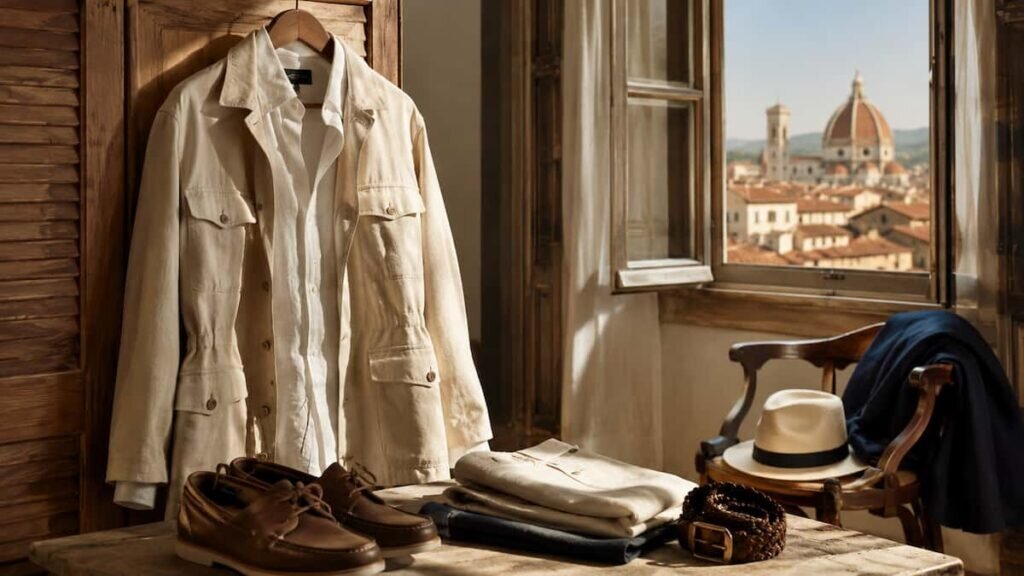
A worn jacket does not enter a wardrobe in the same way as a new one.
It already has a posture. The fabric has learned where the body bends. The sleeve may have softened at the elbow. The collar may no longer sit with showroom precision. The surface carries small signs of use: not enough to make the garment careless, but enough to make it human.
This is why the return of lived-in menswear matters.
At a time when luxury often tries to look flawless, some of the most interesting signals in menswear are moving in the opposite direction. They point toward garments that do not erase time. They use it.
Pitti Uomo 110, held in Florence from 16 to 19 June 2026, arrives at a moment when menswear is again questioning what elegance should look like. Not only the sharp line of tailoring, not only the performance of newness, not only the polished image of luxury, but the quieter authority of clothes that seem able to stay.
For vintage fashion, this is not a minor detail. It is the central question.
What makes a garment worth keeping?
Florence, Menswear, and the Value of Continuity
Pitti Uomo has always been more than a trade fair. Its public image is tied to Florence, tailoring, buyers, international menswear culture, and a particular kind of visual theatre. The event has long helped turn men’s clothing into something observed, photographed, discussed, and performed.
But its deeper value is continuity.
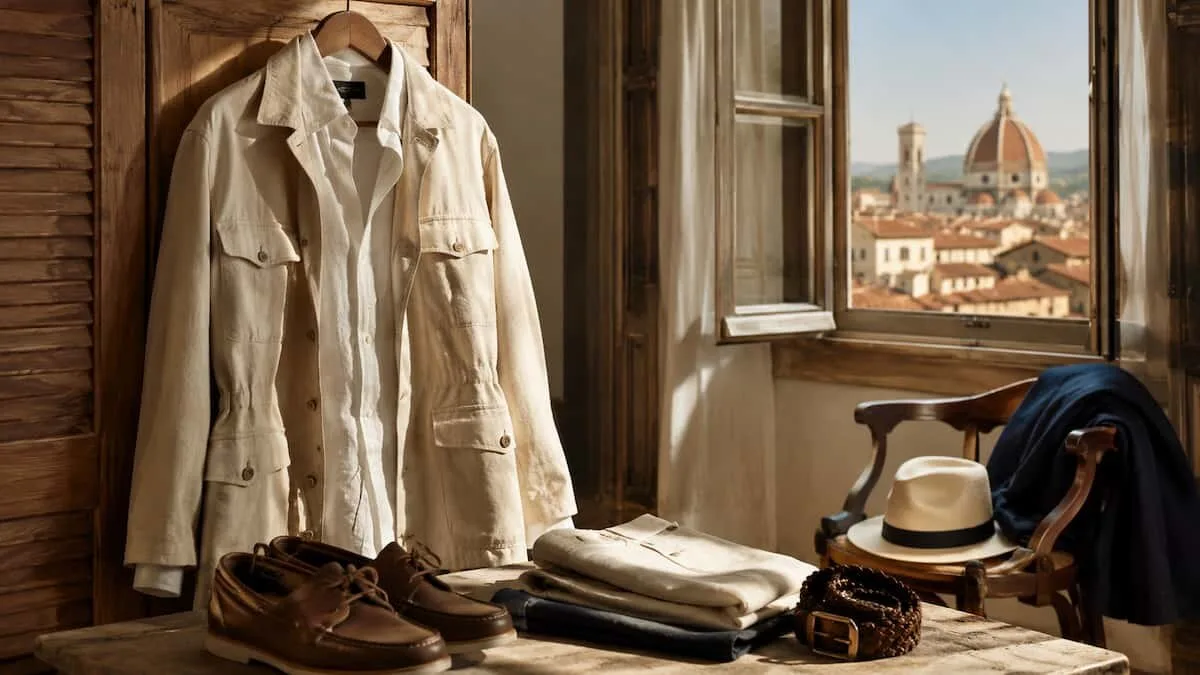
Florence is not a neutral backdrop. It gives menswear a language of stone, craft, proportion, patina, and historical density. A jacket seen there is rarely just a jacket. It is placed against streets, courtyards, palaces, old walls, and a city that understands the long life of surfaces.
That matters for vintage.
Vintage menswear is not simply about buying old clothes. It is about understanding why some garments remain legible after years, while others lose meaning almost immediately. A good coat, a pair of leather shoes, a work jacket, a blazer, a trench, a wool trouser or a well-cut shirt can hold time because it was built with material intelligence.
This is the difference between aging and merely becoming used.
The New Interest in Clothes That Do Not Look New
The fashion system has spent years teaching consumers to recognize the visual codes of newness: perfect surfaces, controlled styling, seasonal urgency, immediate desirability. Resale and vintage have complicated that logic.
The most convincing vintage pieces rarely look untouched.
They look alive.
That does not mean damaged, dirty, exhausted or nostalgic in a sentimental way. It means that the object has developed a relationship with use. Denim fades where the body moves. Leather darkens where it is touched. Cotton softens. Wool relaxes. Hardware loses its artificial brightness. A garment becomes more specific.
In menswear, this is especially powerful because many male wardrobe archetypes were designed around function before image:
- the work jacket;
- the trench coat;
- the military coat;
- the blazer;
- the chore jacket;
- the leather loafer;
- the wool overcoat;
- the oxford shirt;
- the denim jacket;
- the tailored trouser.
These pieces do not need to be reinvented every season to remain relevant. Their strength is adaptation.
They absorb the life around them.
Simone Rocha and the Softening of Masculine Codes
One of the most discussed elements of Pitti Uomo 110 is Simone Rocha’s role as guest designer. The Irish designer is presenting her first standalone menswear show at the 110th edition of Pitti Uomo, after previously integrating menswear into her broader runway work.
Her presence is interesting for a vintage audience because Rocha’s work often treats clothing as emotionally charged material. It does not approach masculinity only through severity, utility or classic tailoring. It allows softness, embellishment, romanticism, fragility and historical reference to enter the male wardrobe.
This is not vintage in the narrow sense.
It is not about reproducing old clothes.
But it is deeply connected to the vintage gaze because it asks the same question: can a garment carry memory, contradiction and personal history without becoming costume?
The answer matters.
The most interesting menswear today is not always the most radical in silhouette. Sometimes it is the most willing to disturb a familiar code: a utilitarian garment with a delicate surface, a strict coat with a softer emotional register, a masculine uniform interrupted by craft, ornament or vulnerability.
Vintage teaches us to read those interruptions.
Why Worn-In Does Not Mean Careless
There is a common mistake in the way worn-in clothing is discussed.
It is often confused with negligence.
But a lived-in garment is not the same as a neglected one. The difference is visible in condition, structure and care.
A good vintage piece may show time, but it should still have integrity:
- seams that remain strong;
- fabric that has softened without collapsing;
- leather that has developed patina without cracking beyond repair;
- lining that can be restored or replaced;
- buttons, zippers or hardware that still support use;
- proportions that can live in a contemporary wardrobe;
- signs of repair that add information rather than disguise damage.
This is where vintage becomes a form of visual education.
It teaches the eye to distinguish character from decay.
A faded jacket may be beautiful. A jacket with unstable fabric may simply be fragile. A scuffed shoe may have depth. A shoe with a broken structure may no longer serve the body. A repaired coat may be more interesting than a pristine one. A badly altered coat may have lost the reason it was worth saving.
The point is not to romanticize every mark.
The point is to understand what the mark means.
The Vintage Menswear Checklist
When looking for vintage menswear, especially pieces with a worn-in quality, the first question should not be “Does it look old?”
The better question is:
Can this garment keep living?
Look at the fabric first. Wool, cotton, linen, leather and denim can age beautifully, but only when the structure remains sound. Thin elbows, brittle folds, stains that have changed the fiber, or moth damage near stress points require caution.
Look at construction. A jacket with good internal structure, clean shoulder line, strong seams and thoughtful finishing will usually age better than a garment made only for surface effect.
Look at proportions. Vintage menswear can be generous, narrow, boxy or elongated depending on decade and function. The question is not whether it follows a current trend. The question is whether the proportion can be worn with intention today.
Look at repairs. Visible mending, replaced buttons, reinforced seams or altered hems can add value when done well. They show continuity of use. But repairs should support the garment, not hide a structural failure.
Look at the reason you want it. If the answer is only “because it looks vintage,” pause. The strongest pieces usually have a clearer reason: cut, material, maker, function, patina, rarity, versatility or emotional pull.
From Trend to Wardrobe Intelligence
The return of worn-in menswear should not become another fast trend.
That would miss the point.
Its value is not in making new clothes look artificially old. Its value is in changing how we judge clothes. Instead of asking only whether something looks current, we can ask whether it can survive attention, use, repair and repetition.
This is where vintage and contemporary menswear meet.
A new collection may suggest a mood. A vintage garment can test whether that mood has substance. If the desire is for softer tailoring, lived-in surfaces, useful pieces, emotional detail and clothes with memory, then vintage is not a side category. It is one of the best places to learn the language.
Pitti Uomo 110 makes this conversation visible because Florence is a city where time is never neutral. It is written into stone, leather, fabric, markets, workshops and wardrobes.
The most interesting menswear now may not be the piece that looks untouched.
It may be the one that still has a future because it already has a past.
Join our Community: