
A vintage silk scarf is small enough to disappear inside a drawer.
That is part of its charm.
Unlike a coat, a handbag or a dress, it does not ask for much space. It can be folded into a square, hidden between tissue paper, passed from one wardrobe to another, forgotten for years and then returned to use with almost no ceremony.
But the best vintage silk scarves are not minor accessories.
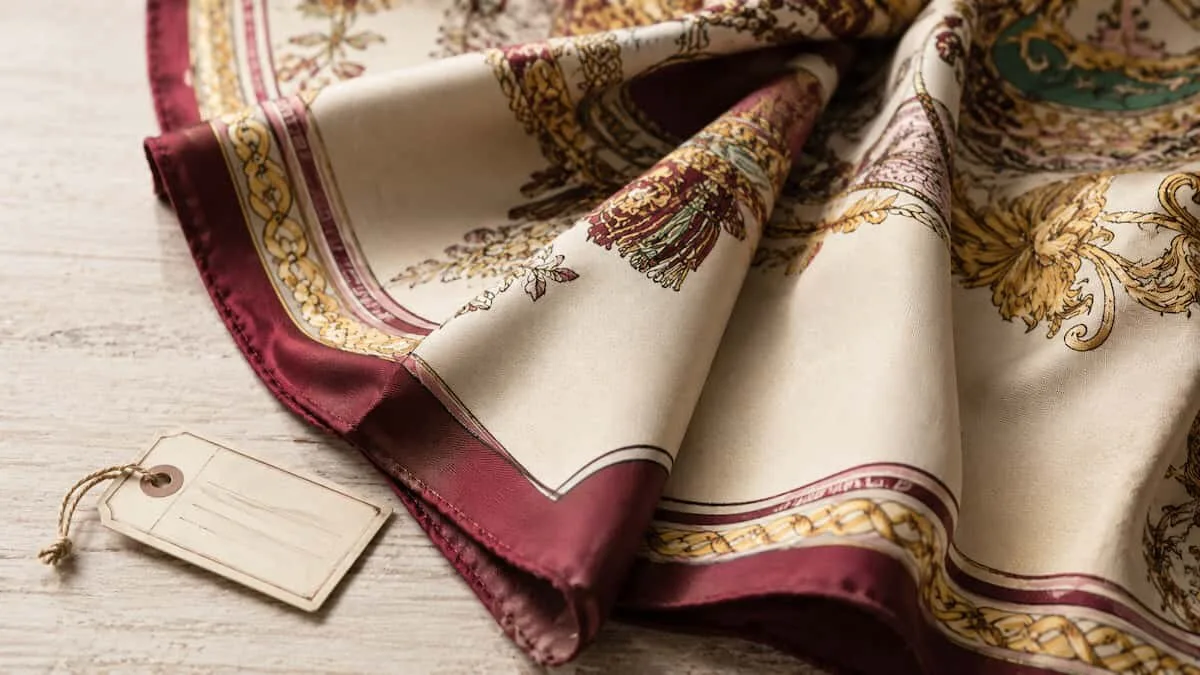
They are printed textiles, miniature archives, records of color, hand, proportion and taste. A square of silk can carry a house code, a graphic language, a memory of travel, a museum reference, a floral vocabulary, a horse motif, a border, a signature, a rolled hem, a decade.
This is why the renewed interest in the silk scarf matters.
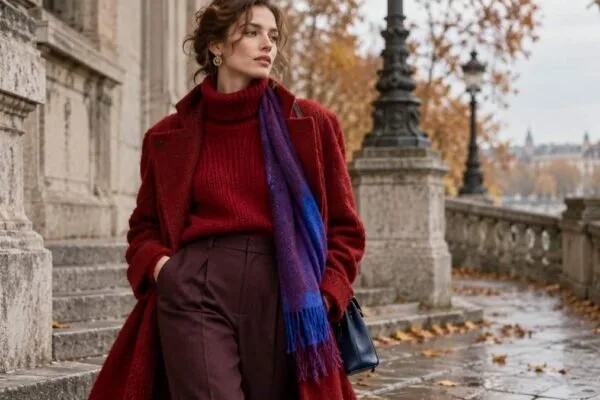
The foulard is visible again on runways and in street style: tied around the head, used as a top, slipped through a belt loop, knotted on a bag, worn under a blazer or treated as a soft alternative to jewelry. But vintage buyers should not look at a scarf only as a trend.
They should read it as a textile object.
Why the Silk Scarf Keeps Coming Back
The silk scarf returns because it solves a problem that fashion repeatedly creates for itself.
It offers change without replacing the whole wardrobe.
A printed square can alter a black coat, a white shirt, a trench, a summer dress or a simple knit. It can make a neutral outfit look intentional. It can soften tailoring, sharpen denim or bring color close to the face without turning the entire look into a statement.
That flexibility explains why the scarf has moved easily between generations.
It has belonged to royal wardrobes, bourgeois codes, travel dressing, cinema images, vintage shops, luxury archives and contemporary styling. Hermès helped define the modern printed silk carré after launching its scarf in 1937. Gucci’s Flora scarf, created in 1966 for Grace Kelly by Vittorio Accornero, turned a floral print into a lasting symbol of Italian style.
These examples matter because they show what a scarf can become when design, material and memory meet.
Not every vintage scarf is rare. Not every silk square is valuable. Not every branded scarf is interesting.
But a good one has a specific kind of presence.
It can be worn, studied, collected and preserved.
Start with the Fabric
The first question is simple: does the scarf feel like real silk?
Silk has a particular hand. It is smooth, but not plastic. Light, but not empty. It can be fluid without becoming limp. Twill silk, often used for luxury scarves, has a fine diagonal weave that gives the fabric body and helps the print hold its clarity.
When you handle a vintage silk scarf, look for:
- a soft but structured drape;
- color that sits clearly on the surface;
- a weave that feels compact, not loose or papery;
- no stiff synthetic shine;
- no crackling finish that suggests poor storage or damage.
Some scarves are silk blends, polyester, acetate or rayon. They can still be attractive and wearable, but they should not be priced or described as pure silk unless the label or material evidence supports it.
If the scarf has no label, do not rely on touch alone. Look at the weave, the edges, the print, the age of the label if present, the quality of the hem and the way the fabric reacts to light.
Vintage buying is not a single test.
It is a chain of clues.
Read the Hem
The edge of a scarf often tells the truth faster than the center.
Many quality silk scarves have hand-rolled hems. The fabric is rolled and stitched so the edge has a soft, raised finish. On better pieces, the stitching is small, regular and integrated into the structure of the scarf. The edge should not look bulky, flatly machined or carelessly overlocked.
This does not mean every machine-finished scarf is bad.
It means the hem should match the claimed quality, age and price.
A hand-rolled edge on a printed silk scarf suggests a different level of production from a simple machine-stitched border. It also affects how the scarf falls. A good edge gives the square a subtle weight. It helps the scarf hold a knot without looking rigid.
Check the corners carefully.
Corners reveal shortcuts. If the roll becomes messy, thick or uneven, the finishing may be weak. If the thread is broken in several places, the scarf may still be wearable, but it needs gentler use and a lower price.
Look at the Print as a Composition
A scarf is not only a pattern.
It is a composition designed to be folded.
This is one reason vintage scarves can be more interesting than many ordinary printed accessories. A good scarf works when seen flat, but it also works when only a border, a corner or a diagonal section is visible.
Lay the scarf open and study:
- the border;
- the central motif;
- the corners;
- color registration;
- line definition;
- whether the design still makes sense when folded.
The best printed scarves often have a strong border because the border frames the object when it is tied. Corners matter because they frequently remain visible. A dull center can still become a beautiful scarf if the edges carry rhythm and color.
For vintage Gucci, Hermès, Pucci, Leonard, Roberta di Camerino, Vera and other collectible names, the print language is part of the value. But the name should not replace looking.
The question is not only who made it.
The question is whether the design still speaks when worn.
Signs of Age Are Not Always Defects
Vintage silk scarves often show small signs of life.
That is normal.
The question is whether age has become character or damage.
Acceptable signs can include:
- a very small pull near the edge;
- slight softening of the silk;
- minor color fading if even and not visually disruptive;
- gentle fold memory;
- a label with age-related wear.
More serious issues include:
- stains at the center or near the face line;
- shattered silk, where the fibers become weak or split;
- strong perfume or storage odor;
- dye bleeding;
- holes;
- large pulls across the print;
- brittle areas caused by poor storage or sunlight.
A scarf can be beautiful and still not be a good purchase.
Silk is durable when cared for, but old silk can become fragile. If the fabric feels dry, sharp, powdery or unusually stiff, be cautious. A scarf that looks excellent in a photograph may not survive repeated tying if the fibers have lost strength.
Check Wearability Before Collectability
Some scarves are best collected.
Others are meant to be worn.
Before buying, decide which one you are looking at.
If the scarf is rare, very delicate, signed, museum-worthy or expensive, you may choose to preserve it more than wear it. If it is beautiful but not fragile, it can become one of the most useful vintage accessories in a wardrobe.
For wearability, ask:
- Is the size useful for how I dress?
- Does the color work near my face?
- Can I tie it without stressing the fabric?
- Are the stains hidden when folded?
- Is the silk strong enough for regular use?
- Does the print look better open or tied?
A 90 x 90 cm square is the classic versatile format: neck, head, belt, bag, top, shoulder. Smaller scarves can be elegant at the neck or wrist. Long scarves and stoles have a different movement and can be easier over coats.
Do not buy only the flat image.
Imagine the fold.
How to Store and Care for Vintage Silk Scarves
Silk needs respect, not fear.
Store vintage scarves clean, dry and away from direct sunlight. Avoid plastic bags for long-term storage, especially if the scarf is valuable. Use acid-free tissue paper when folding, and do not press the same fold lines forever. If a scarf is fragile, flat storage is better than hanging.
For cleaning, be conservative.
Many vintage silk scarves should be handled by a specialist cleaner, especially if they are branded, hand-rolled, brightly printed or already fragile. Water can affect dyes. Heat can damage fibers. Aggressive stain treatment can make a small mark worse.
If a scarf has odor, air it gently in shade before doing anything more invasive.
Never treat an old silk scarf as if it were an ordinary modern synthetic accessory.
The point is not to make it look new.
The point is to keep it alive.
What Makes a Vintage Silk Scarf Worth Buying
A vintage silk scarf is worth buying when quality, condition, design and use meet.
The label can help, but it should never do all the work.
Look for a scarf that has:
- good silk or a clearly identified quality fabric;
- a finished edge that matches the price;
- a print with strong composition;
- condition that allows the use you want;
- colors that still feel alive;
- a scale that works with your wardrobe;
- enough cultural or visual interest to outlast the current trend.
This last point is important.
The scarf is fashionable again, but the best vintage pieces do not depend on that. They have already survived one or more cycles of taste. Their value is not only that they can be styled in a contemporary way.
It is that they have kept their voice.
The Small Archive You Can Wear
A vintage silk scarf teaches a useful kind of attention.
It asks you to look at borders, corners, labels, hems, color, touch and signs of use. It reminds you that fashion history is not only held in gowns, runway photographs and museum exhibitions.
Sometimes it is folded into a square.
Sometimes it is tied around a handle.
Sometimes it waits in a drawer until someone understands that a small object can still carry a large amount of style, memory and craft.
That is the real reason the vintage silk scarf endures.
It is not only easy to wear.
It is easy to keep reading.
Join our Community: