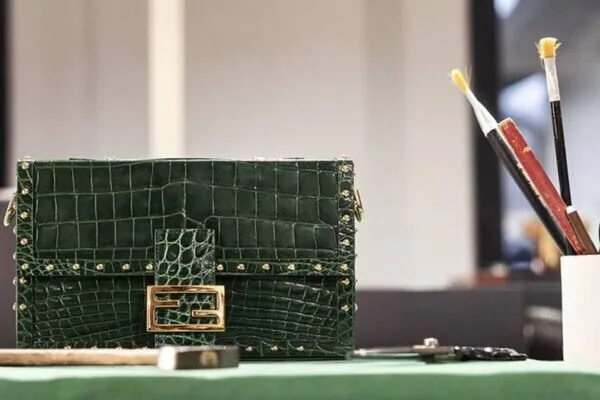
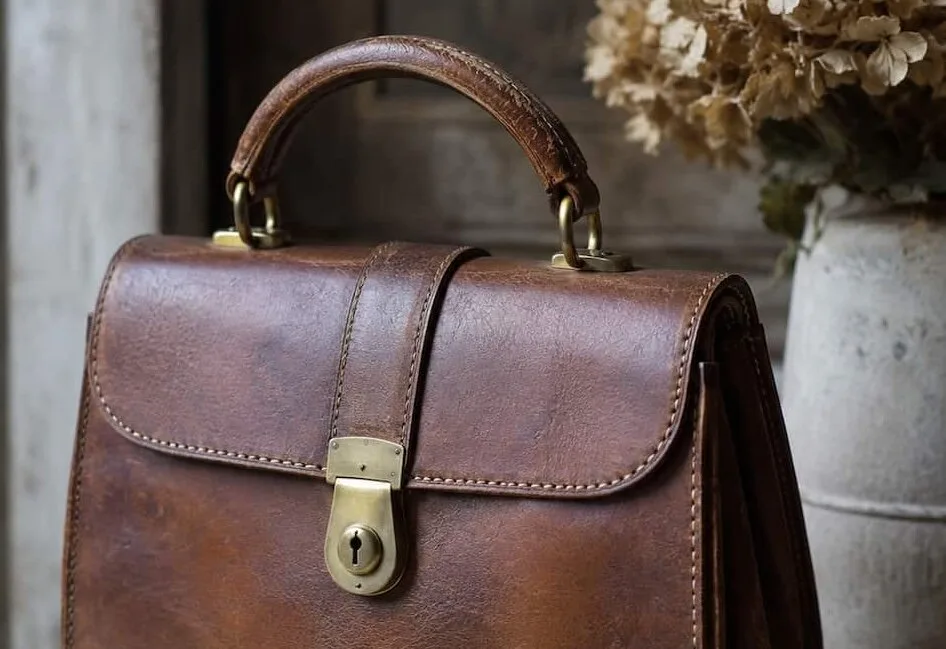

A vintage bag should be read before it is recognised.
That is the step many buyers skip.
The eye goes first to the name: the monogram, the clasp, the familiar shape, the promise of a house with history. A logo can make a bag easier to identify. It can also make the eye less patient.
The risk, when buying vintage bags, is not only buying a fake.
It is buying a name attached to an object that no longer works as a bag.
The more useful question is not simply:
Is it authentic?It is:
Is it still materially convincing?A vintage leather bag is not just a brand document. It is a small structure. It has a body, a surface, a weight, a way of standing or collapsing. It has handles that have carried something, corners that have met tables and wardrobes, a lining that has kept the private debris of ordinary life.
It is an object of use before it is an object of desire.
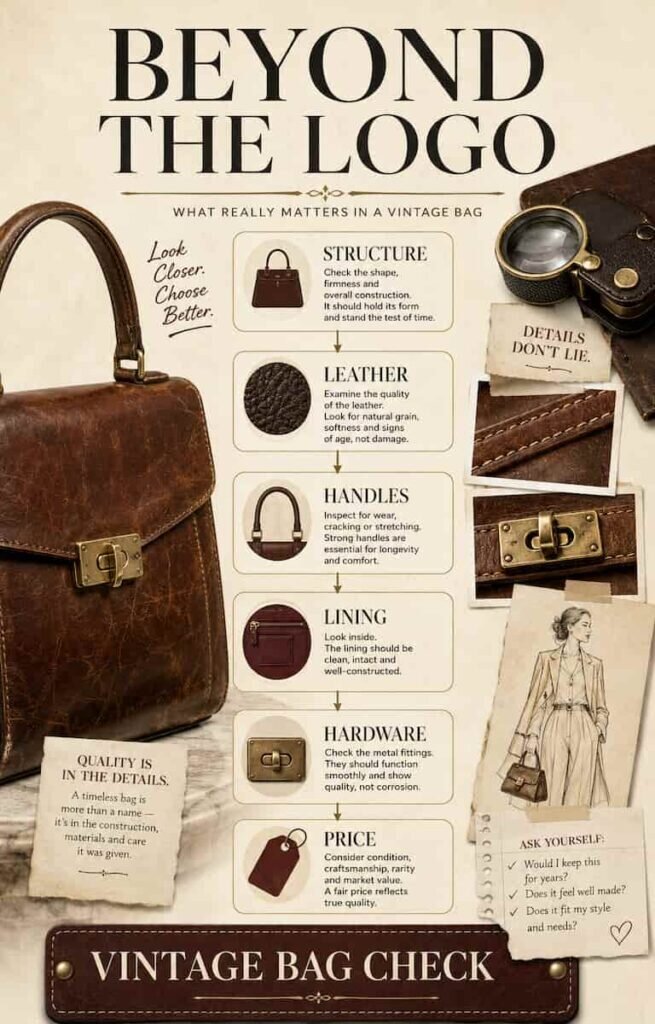
Why the Logo Is Only the First Clue
Some vintage bags are valuable because of the house behind them.
That is real.
Gucci, Bottega Veneta, Prada, Fendi, Hermes, Chanel, Valextra and other houses shaped the language of twentieth-century accessories in different ways. Bamboo handles, woven leather, nylon, structured top handles, saddle shapes, chain straps, monograms and quiet hardware all belong to fashion history.
But the logo is not the whole value.
A tired branded bag can be less interesting than an anonymous leather bag with excellent structure, beautiful ageing and a useful shape. Vintage, at its best, teaches the eye to separate recognition from quality.
Recognition is immediate.
Quality takes longer.
That is why the first check should not be the logo. It should be the object.
Start With the Body of the Bag
Before looking for stamps, codes or certificates, look at the body.
Does the bag still hold its shape?
A structured bag does not need to look new. It should not. But it should still remember its original architecture. The base should not be entirely collapsed. The flap should close without a fight. The handle attachments should not look as if they are carrying the whole past of the object alone.
A soft bag asks for a different reading.
A hobo, pouch or slouchy shoulder bag may not be meant to stand upright. In that case, the question is not structure but fall. Does the leather move with weight and suppleness, or does it look thin, exhausted and emptied out?
Vintage is not perfection.
It is coherence.
Read the Leather Before Reading the Name
Leather is one of the reasons vintage bags remain so interesting.
A good leather surface changes. It darkens, softens and polishes at points of contact. It can develop a patina that makes the bag more specific, not less valuable. Some vintage bags feel more intelligent than new ones because they have stopped pretending to be untouched.
But patina is not the same thing as damage.
Patina is gradual. It belongs to use.
Damage interrupts use.
Look carefully for:
- deep cracking;
- sticky surfaces;
- flaking coatings;
- strong mildew smell;
- torn handle bases;
- opened edges;
- unstable linings;
- colour transfer;
- repairs that were not declared.
Sometimes damage is acceptable if the price reflects it and the repair is possible.
Often it is the future cost of the bag.
The practical question is simple:
Does this mark tell a story, or does it shorten the life of the bag?Check Stitching, Edges and Handles
The most revealing parts of a vintage bag are often not the parts designed to be seen.
Look at the stitching.
It should be regular, stable and coherent across symmetrical areas. A handmade object may have slight irregularities. A badly made or badly repaired object has tension problems, loose threads, skipped stitches and seams that pull against the leather.
Look at the edges.
A good edge is never accidental. It may be folded, painted, burnished, reinforced or lacquered, but it should not be separating in a way that exposes the layers of the bag without control.
Look at the handles.
They are the biography of the bag. They show where it was held, how often, with what pressure and in what condition. Darkening is not automatically a problem. Cracking near the attachments is.
A bag can photograph beautifully and still have weak handles.
That matters because a vintage bag should still be able to enter a wardrobe.
The Lining Tells a Different Story
The interior is often more honest than the exterior.
A clean, coherent lining suggests care. A stained lining does not automatically ruin a bag, but it changes the decision. Ink, cosmetics, humidity, sticky coatings and persistent odours can be difficult to remove.
If you are seeing the bag in person, smell it.
Vintage can have a light trace of age. It should not smell strongly of mildew, smoke, basement, perfume used to cover another smell, or solvent.
If you are buying online, ask for clear images of:
- the lining;
- inside pockets;
- corners;
- handle attachments;
- bottom;
- zippers;
- closure;
- labels or stamps;
- any repaired area.
An elegant description is not evidence.
The images have to show the parts that use will test first.
Hardware and Closure Are Not Secondary
Zippers, clasps, buckles, feet, chains and magnetic closures should feel coherent with the bag.
They should not look too new for the rest of the object, too light for the material, or inconsistent with the period and model.
A replaced part is not always a problem.
It is a disclosure issue.
If hardware has been replaced, the seller should say so. On an everyday bag, a clean repair may be acceptable. On a collectible luxury bag, it can affect value more seriously.
Open and close the bag if possible.
A zipper that does not run smoothly may only need cleaning. It may also reveal a distorted body, worn teeth or a weak slider. A closure that pulls against the leather can be a sign that the bag has lost shape.
Function is part of value.
Authenticity Is a Pattern
The vintage luxury market trains buyers to look for magic clues.
A stamp. A serial number. A receipt. A dust bag. A particular shade of thread. A date code. A tiny mark inside a pocket.
These things can matter.
They do not matter alone.
Authenticity is a pattern of coherence. Model, period, material, construction, hardware, lining, provenance, price and wear should speak the same language.
When one element is too perfect, too vague, too new or too convenient, it deserves attention.
This is why professional authentication still matters for expensive or heavily counterfeited bags. Not every buyer has to become a forensic expert. But desire makes shortcuts attractive, and a vintage bag with a famous name asks for slower looking.
Price Should Reflect Condition, Not Only the Name
A vintage bag is not a good buy simply because it costs less than a new one.
It is a good buy when price, condition, use, repair risk and desirability are aligned.
Before buying, consider:
- cleaning costs;
- leather restoration;
- edge repair;
- handle repair;
- zipper or hardware issues;
- missing documents;
- seller reputation;
- return policy;
- comparable prices;
- whether you will actually use the bag.
The real bargain is not the lowest price.
It is the bag that does not ask to be justified after it arrives.
A Practical Vintage Bag Checklist
Before buying a vintage leather bag, ask:
- Does the shape still make sense?
- Is the leather ageing or failing?
- Are the handles safe to use?
- Are the edges stable?
- Does the hardware work?
- Is the lining clean enough for real life?
- Is the smell acceptable?
- Are repairs visible, declared and well done?
- Is authenticity supported by more than one clue?
- Does the price reflect condition, not only the name?
The right vintage bag does not need to be flawless.
It needs to be honest.
It should tell you what it has lived through without asking you to ignore what it can no longer do.
The Best Vintage Bags Are Still Usable
The best vintage bags are not frozen in the past.
They can still enter a wardrobe. They can still carry a phone, a notebook, lipstick, keys, receipts and the small disorder of ordinary life. They do not survive because they are preserved as images. They survive because they can still be used.
That is the real test.
Not whether the bag can be identified from across the room.
Whether, once the name has been recognised, the object still deserves attention.
Join our Community: