
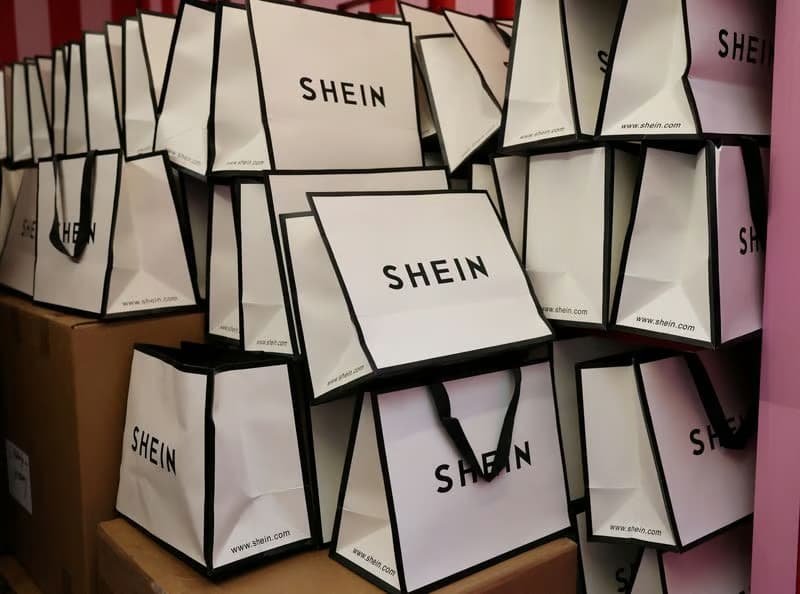

The photo made the rounds within hours: a customer at Le BHV Marais in Paris, standing in Shein’s first-ever physical store, shopping bags in hand, the red logo glowing behind her like a permanent fixture rather than a pop-up. That image, taken back in November, now reads differently. The company that built an empire on the promise of a five-dollar dress just told the stock market, in numbers no marketing team can spin, what that promise actually costs.
A company worth a quarter of what it used to be
Shein priced its Hong Kong IPO on August 31 at $26 billion, raising $1.7 billion by selling roughly 280 million shares. Trading begins tomorrow, September 1, under ticker 00625. Four years ago, in a 2022 private funding round, investors valued the same company at $98.2 billion. The number didn’t slide gently — it dropped to $64 billion in 2023, held there through most of 2024, then kept sliding through failed listing attempts in New York and London before Chinese regulators finally cleared the Hong Kong route in July.
A quarter of the original price tag isn’t a rounding error. It’s a market telling a very specific story about what actually powers ultra-fast fashion — and what happens when the props get pulled away.
The mechanics behind the discount
Shein’s 2025 revenue reached $41.8 billion, up about 8%. That sounds healthy until you set it against the 20.7% growth the year before — a deceleration steep enough to make any prospectus writer sweat. Net profit fell 38.7% to $2.06 billion for the year. Then came the first quarter of 2026: a net loss of $99 million, a sharp reversal from the $395 million profit posted in the same quarter a year earlier, with operating income down 26% to $258 million. Part of that loss came from a $328 million accounting charge tied to the fair-value adjustment of convertible preferred shares — the kind of instrument that quietly punishes a company the moment its valuation drops.
The business pressure is more concrete than an accounting line, though. The U.S. decision to close the “de minimis” duty exemption on small parcels hit directly at the logistics model that made Shein’s prices possible in the first place: no bulk shipping, no warehousing overseas, no import duty on millions of small, direct-to-consumer packages. Remove that exemption, and a $6 top stops being a demonstration of “supply chain efficiency” and starts looking like the temporary byproduct of a regulatory loophole.
Did you know? Shein has committed to paying up to $3.5 billion in cash to early private investors — Boyu Capital, Tiger Global, General Atlantic, Thrive Capital, Mubadala and Brookfield among them — because the final IPO price came in below the levels those investors were promised when they bought in years ago. The public raised $1.7 billion. The obligation to early backers is double that. Newer shareholders got nothing from the arrangement; only the investors holding specific earlier-round shares did.
Price and cost are not the same thing
This is where the story stops being about one company’s balance sheet and starts being about a whole category of fashion. The retail price of an ultra-fast-fashion garment was never a full account of what it cost to produce and move it. It was a price built on a stack of temporary advantages: direct-from-factory shipping that skipped traditional import channels, duty exemptions designed for individual travelers rather than industrial-scale retail, aggressive customer acquisition through paid social, and a manufacturing rhythm — tiny batches, rapid reordering, real-time demand testing — that only works at a punishing pace of turnover.
None of those advantages are permanent. Regulators can close a loophole. Ad costs can rise. Growth can decelerate once a market approaches saturation. When any of those pillars gives way, the retail price stays cheap for a while longer, propped up by margin compression, until the valuation — the market’s honest read of long-term earning power — catches up and tells the truth.
Vintage and secondhand fashion have always made an implicit argument here: that a garment’s real cost includes everything the price tag doesn’t show — the labor conditions behind it, the environmental toll of producing it, and the value that a well-made piece holds for decades rather than months. Shein’s repriced IPO doesn’t prove that argument in a courtroom sense. But it does put a hard number next to it. A $27 billion difference between what a company said it was worth in 2022 and what buyers were willing to pay for it in 2026 is not sentiment. It’s a market correcting for a model that depended on conditions nobody guaranteed would last.
What comes next
Trading opens tomorrow, and the stock will now be priced daily, by strangers, in a way private valuations never were. Whether $26 billion turns out to be a floor or another stop on the way down is a question the market will answer over the coming quarters — through revenue growth, through margin, through how the company absorbs tariff pressure it can no longer route around. What’s already settled is simpler: the price of a five-dollar dress and the cost of making it possible were never the same number. One of them just got repriced in public. The other was always there, waiting to be counted.
Join our community:
t.me/vintageitalian
vintageitalianfashion.substack.com