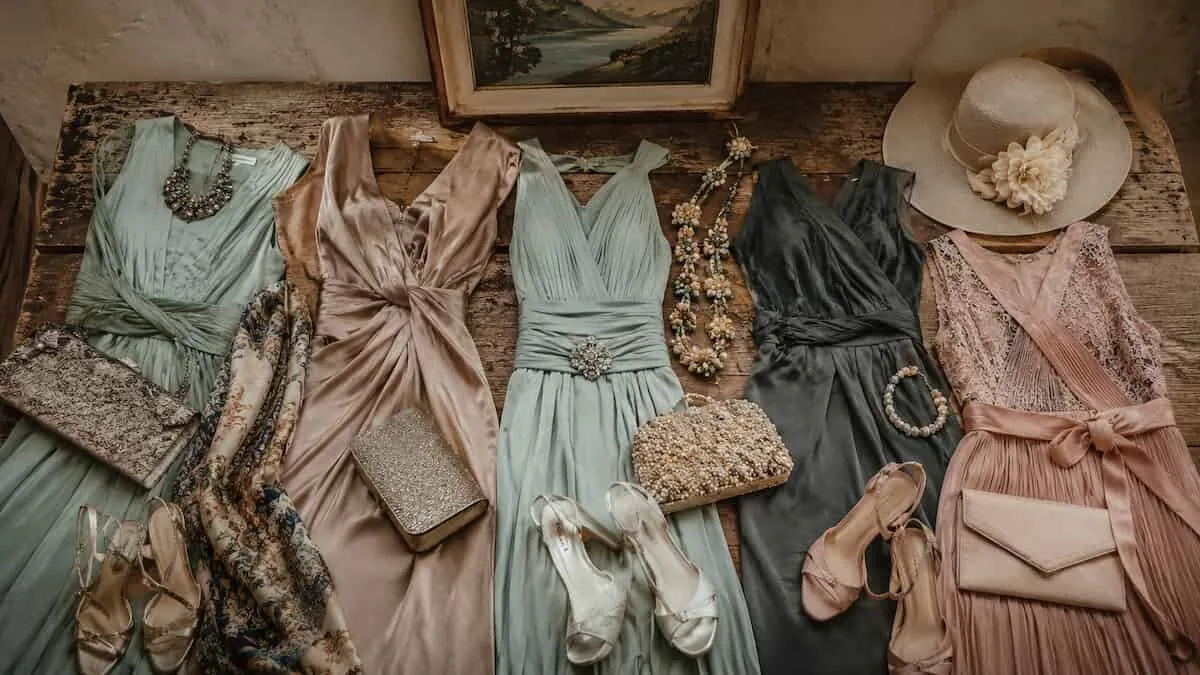

A wedding invitation now arrives with a mood.
Not only a date, a venue and a line about cocktail attire. It may ask for “Amalfi chic”, “old Hollywood glamour”, “colorful cocktail”, “garden formal”, “Riviera ease” or another phrase that sounds charming until the wardrobe door is open and nothing inside seems to speak the right language.
This is where the one-wear economy begins.
It begins with an event that feels special, a dress code that feels highly specific, a camera-ready social setting and the quiet pressure to buy something that may be worn once, photographed once and then left in the closet.
ThredUp has tried to turn that anxiety into a resale opportunity. In May 2026, the US secondhand platform launched Dress Code Decoder, an AI shopping tool designed to translate hyper-specific wedding dress codes and moodboards into curated secondhand looks from its inventory. The examples named by the company are telling: “Amalfi chic”, “old Hollywood glamour” and “colorful cocktail” are not practical categories. They are images.
For vintage fashion, this is the useful part of the story.
The problem is not only that people buy too much for weddings. The deeper problem is that occasionwear is increasingly treated as visual content before it is treated as clothing.
Vintage can change that order.
What Is the One-Wear Economy?
The one-wear economy is the habit of buying an outfit for a single event, wearing it once and then leaving it unused.
ThredUp’s 2026 wedding data gives the phenomenon a concrete shape. According to the company, 87 percent of wedding guests surveyed had bought at least one outfit they wore only once, and 68 percent of those once-worn pieces remained unworn in closets instead of being resold or recirculated. The same report says 58 percent of guests feel wedding dress codes have become more niche than they were five years ago, while nearly one in three guests lack confidence in interpreting modern dress codes.
The numbers are American, and they come from a resale company with a clear commercial interest in solving the problem. They should be read as market data, not as a universal law.
Still, the pattern is recognizable far beyond the United States.
Weddings, destination weekends, summer parties, resort dinners and formal celebrations increasingly ask guests to perform a mood. The outfit is expected to work in person, in photographs, in group shots, on Instagram and in memory. It must feel current, but not too obvious. Formal, but not rigid. Thematic, but not costume-like.
That is a lot to ask from a dress bought in a hurry.
Why AI Dress Code Tools Are Appearing Now
ThredUp’s Dress Code Decoder is interesting because it does not simply search for “wedding guest dress” or “cocktail dress”.
It tries to interpret a phrase.
If a user uploads a moodboard or enters a dress code such as “old Hollywood glamour”, the tool translates that language into shoppable secondhand options. In practical terms, this means AI is being used to reduce the friction of secondhand shopping: too much inventory, too many categories, too little time and too much uncertainty about what a vague dress code actually means.
This is not a minor problem for resale.
Secondhand platforms often have the inventory, but not always the ease. A new fashion site can arrange products by trend, season, campaign and editorial theme. A resale platform must work with what already exists, in different sizes, conditions, brands, decades and levels of quality.
The challenge is not only finding a dress.
It is finding the right dress inside a chaotic archive.
AI can help with that. But it also shows something else: modern consumers are not only shopping for garments. They are shopping for interpretation.
Second Hand Is Not Always Vintage
For Vintage Italian Fashion, there is an important distinction.
ThredUp’s tool is a secondhand shopping tool. That does not automatically make every suggested piece vintage.
Second hand means the item has had a previous owner. Resale means it is being recirculated through a market. Vintage, in a stricter editorial sense, should carry more than previous ownership: period character, material quality, recognisable construction, cultural memory or design value.
This distinction matters especially for occasionwear.
A recent fast-fashion dress resold after one wedding may be secondhand, but it may not offer the same value as a 1990s silk slip dress, a structured 1980s evening jacket, a vintage beaded top, a 1970s printed maxi dress or a well-cut Italian crepe dress that still holds its line after decades.
Both can reduce one-time purchasing.
Only one may also teach the wearer something about cut, fabric, proportion and fashion history.
That is where vintage becomes more than a cheaper alternative. It becomes a better way to read the dress code.
Why Vintage Occasionwear Works for Modern Dress Codes
The new dress codes sound contemporary, but many of their references are historical.
“Old Hollywood glamour” points toward bias cuts, satin, velvet, draped necklines, long gloves, evening bags, soft waves and controlled shine. “Amalfi chic” suggests linen, silk scarves, citrus colors, white trousers, fine sandals, raffia, gold earrings and the easy discipline of Mediterranean holiday dressing. “Garden formal” often wants florals, pastels, silk, organza or a polished dress that can survive grass, heat and photography.
Vintage is strong here because it does not need to imitate these moods. It often comes from the visual language that contemporary dress codes are trying to borrow.
A 1970s printed dress can read resort without needing a resortwear label. A 1990s bias-cut slip can answer a minimalist evening dress code better than many new satin dresses. A structured 1980s jacket over a simple dress can make cocktail dressing feel more personal. A silk scarf, a small evening bag or a pair of vintage earrings can shift a familiar dress into a different register without buying a full new outfit.
The smartest wedding guest wardrobe is not built around single-use dresses.
It is built around pieces that can move.
How to Choose Vintage for a Wedding or Formal Event
The first question is not “is it beautiful?”.
The first question is:
can this piece survive the event and still belong to my wardrobe?
For vintage occasionwear, look at five things.
Fabric
Silk, wool crepe, viscose, cotton, linen, quality lace and well-preserved velvet often carry evening or ceremony dressing better than weak polyester blends. This is not a rule against synthetics: some vintage synthetics have charm and structure. But the fabric must still have life.
Check for shine that looks intentional, not tired. Look at the seams, lining, underarms, hem and closures. Occasionwear is often stored for years, and storage can be as damaging as wear.
Construction
A dress for a wedding has to move, sit, photograph and last several hours. Examine zippers, straps, buttons, boning, waist seams, sleeve openings and lining. A beautiful dress that cannot be worn comfortably will become another one-wear piece, even if it is vintage.
Proportion
Modern dress codes often respond well to vintage proportions: a longer skirt, a neat waist, a cropped jacket, a draped neckline, a sharper shoulder, a narrow slip silhouette. The goal is not to dress like a period photograph. It is to use proportion as a way to make the outfit feel intentional.
Alteration Potential
Many vintage pieces become wearable because of small alterations: shortening a hem, adjusting straps, replacing buttons, repairing a lining, changing a belt. Avoid pieces that require structural changes unless they are exceptional. The best vintage occasionwear needs respect, not rescue.
Rewear Value
Before buying, imagine at least three future uses.
A wedding in June. A dinner in September. A holiday evening next year. A jacket over trousers. A slip dress under knitwear. A scarf with a white shirt. If the piece cannot move beyond one event, it is still trapped in the logic of the one-wear economy.
What to Wear for “Amalfi Chic” Without Buying a Costume
“Amalfi chic” is one of those phrases that can become costume very quickly.
The better route is restraint.
Think of texture, light and proportion rather than postcard imitation. A vintage linen dress, a silk scarf, a printed 1970s skirt, white or cream trousers, a fine woven bag, a simple gold earring and low sandals can suggest the mood without turning the guest into a tourist-board image.
The Italian element should not be reduced to lemons and blue tiles.
It can be a way of dressing with ease and precision: breathable fabric, a controlled palette, a piece that moves well in heat, an accessory with character, nothing too forced.
This is where vintage Italian fashion has a natural advantage. The best pieces often understand summer as a matter of material intelligence, not decoration.
What to Wear for “Old Hollywood Glamour” in a Vintage Way
“Old Hollywood glamour” is another phrase that can go wrong when read too literally.
It does not require a costume, a feather boa or a dress that looks as if it belongs to a themed party.
A vintage reading is more precise: bias-cut satin, velvet, a clean black dress, a small beaded bag, a low neckline balanced by a longer hem, a silk wrap, a red lip if it suits the wearer, or a single piece of jewellery that has presence.
The point is not to recreate a film still.
It is to borrow the discipline of evening dressing: line, shine, restraint and confidence.
The Smarter Alternative to One-Wear Shopping
ThredUp’s tool is useful because it recognises a real problem. Guests are tired of decoding dress codes, spending time searching and buying pieces that may not return to daily life.
But the most interesting answer is not only faster shopping.
It is better choosing.
AI can translate a phrase into options. Resale can redirect demand away from new single-use purchases. Vintage can go one step further by asking whether the piece has enough quality, character and flexibility to remain useful after the event.
This is the difference between buying an outfit and building an occasionwear wardrobe.
The first solves Saturday.
The second changes how you dress for the next five invitations.
The Vintage Rule for Modern Dress Codes
The more specific the dress code, the more useful vintage can become.
Not because vintage is automatically sustainable, or because every secondhand dress deserves attention. It is useful because it already contains references, textures and proportions that contemporary fashion keeps trying to recreate.
The one-wear economy turns events into reasons to buy.
Vintage occasionwear can turn them into reasons to choose better.
A dress worn once is an outfit.
A dress that can return, change context and still feel alive is something else.
It is a wardrobe beginning to remember itself.
Join our Community: